Two significant books about hypervigilance are scheduled to arrive within one week of each other in January 2027. Dr. Kim Sage's Hypervigilant arrives on January 12, followed by Ben Ahrens' The Hypervigilant Brain on January 19. Their approaches differ, but their near-simultaneous publication suggests that the conversation about living on alert is reaching a wider audience. I welcome that attention because, for several years, I have been exploring a related question through my work at MI.BO. and the development of NeuraGrip™. What happens when a difficult situation has ended, yet aspects of our readiness appear to continue?
The Contradiction That Interested Me
Most conversations about stress begin with how someone feels. We ask whether they are anxious, overwhelmed or having difficulty coping. These are important questions, but I became interested in another possibility. Someone may sincerely describe themselves as feeling fine while aspects of their measured physiology tell a different, though not necessarily alarming, story.
Through MI.BO., our observational work has involved more than 300,000 anonymised physiological readings. That experience encouraged me to examine the relationship between self-perception and the information we obtain from the body. A heart-rate or HRV reading cannot determine whether someone is hypervigilant, traumatised or anxious. It can, however, raise a question worth exploring when interpreted in the appropriate context.
I began thinking about this distinction as Felt vs Measured. What someone reports and what physiological technology observes are different sources of information. Neither should automatically invalidate the other.
Published research provides an important reason to take this distinction seriously. A 2021 systematic review by Vaessen and colleagues, examining 36 studies, found that self-reported stress and cardiovascular measures were not consistently associated in everyday life. The relationship was influenced by what was measured, how stress was reported and the circumstances in which observations were made.
For me, that reinforces the value of asking better questions rather than assuming that a physiological measurement can reveal someone's psychological state.
When the Demand Ends but Readiness Appears to Continue
Consider someone who has just completed a difficult project, returned home after a demanding journey or finally resolved a prolonged disagreement. The immediate demands may have ended, yet they might still notice tension in their jaw, difficulty settling into sleep or an uncomfortable sense of remaining switched on.
These experiences are not proof of hypervigilance or autonomic dysfunction. They can have several explanations. But they are familiar enough to deserve attention rather than automatic dismissal.
In YOU ARE NEURAGRIPPED, I call these everyday recognition prompts Feelers. Examples include Jaw Clench, Morning Fog and Background Hum. Their purpose is to encourage observation, not diagnosis.
Readers can explore these examples through the NeuraGrip Discover experience, where each Feeler opens a question about something that may have become so familiar that we no longer stop to notice it.
Hypervigilance Has a Specific Clinical Meaning
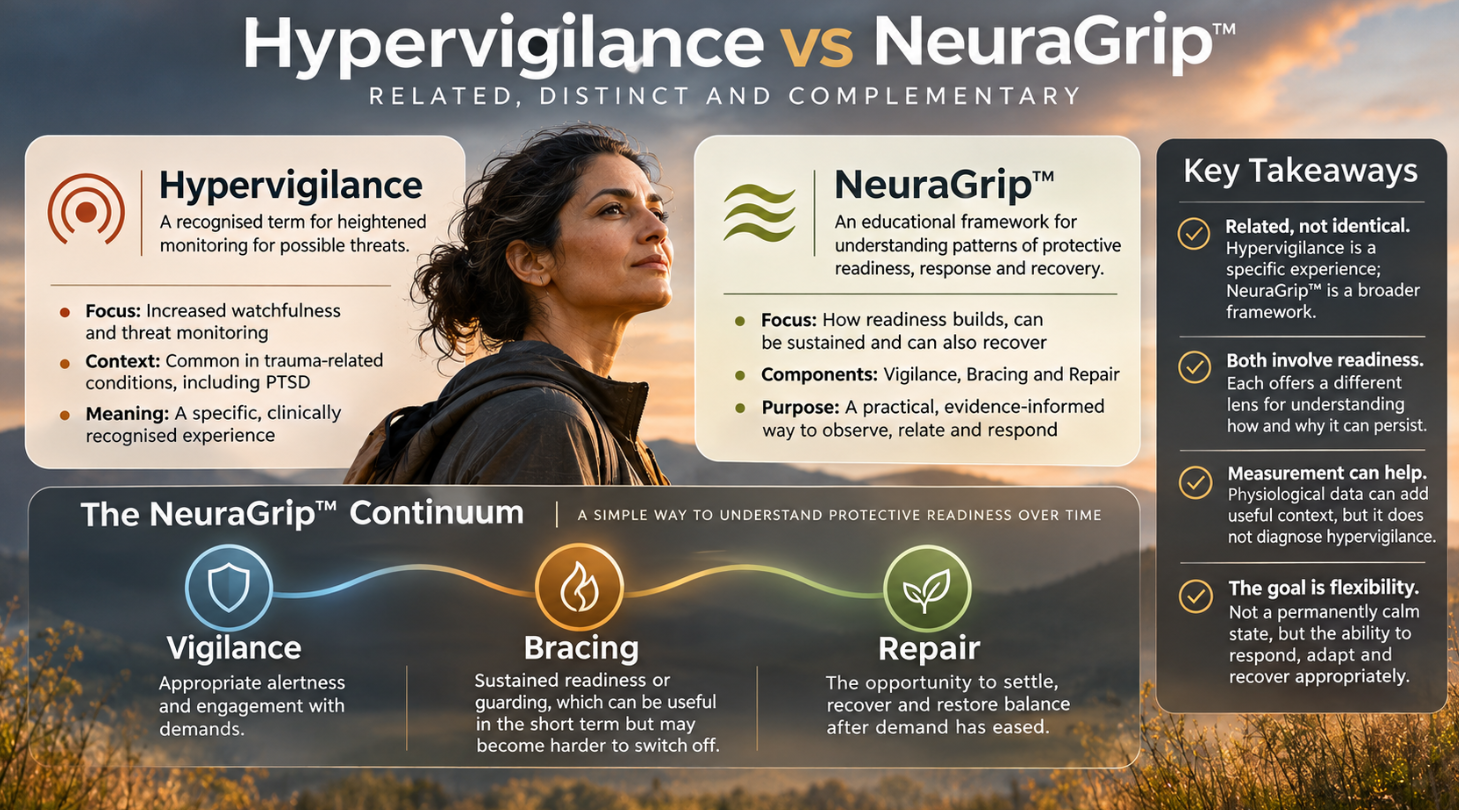
Hypervigilance involves heightened monitoring for possible danger. It is recognised among the symptoms associated with post-traumatic stress disorder, but experiencing heightened watchfulness does not, by itself, establish PTSD or another psychiatric diagnosis.
The scientific literature also shows that threat-related attention is more complicated than simply detecting danger faster. A systematic review by Lazarov and colleagues found relatively consistent evidence for sustained attention towards threatening information in PTSD, while findings for accelerated threat detection were less consistent.
I find that distinction important. Our attention may be drawn towards possible danger, remain occupied by it or become difficult to redirect. These processes are related, but they are not identical, and their patterns vary between individuals and circumstances.
Where Autonomic Bracing Enters My Thinking
There is a broader physiological question alongside the study of threat-related attention. How does the body adjust when demands increase, and what happens when those demands have diminished?
Research on allostasis has helped explain how physiological systems support adaptation. Bruce McEwen's work also examined the consequences of repeated activation and situations in which stress responses do not settle efficiently.
This scientific foundation contributed to my interest in what I call autonomic bracing. It is a proposed concept within NeuraGrip™ for investigating patterns of sustained protective readiness.
I want to be precise about that description. Autonomic bracing is not an established diagnosis, a newly discovered biological system or a clinically validated explanation for hypervigilance. It is a hypothesis that requires further research.
Within NeuraGrip, I use the classifications Vigilance, Bracing and Repair to organise educational discussions about readiness and recovery. These classifications are framework interpretations, not clinical determinations of someone's autonomic state.
Measurement Can Help. It Can Also Mislead Us.
We now have remarkable access to physiological information. Heart rate, HRV, respiratory patterns and sleep measurements can help us observe changes that might otherwise escape our attention.
But I have become increasingly concerned about the confidence with which some wellness technologies interpret these measurements.
A low HRV reading cannot diagnose hypervigilance. A higher resting heart rate cannot independently establish that someone's nervous system is dysregulated. Breathing, posture, activity, sleep, illness, medication and recording conditions can all influence the results.
Scientific guidelines published by Quigley and colleagues in 2024 emphasise that heart-rate and HRV measurements cannot be mapped directly onto one psychological state across different contexts.
Through MIBOSelfie™, we are developing ways to make selected physiological observations more accessible. The related Face vs Felt experience allows users to compare what they report with camera-derived physiological context.
I believe that comparison can be useful when its limitations remain visible. An apparent disagreement between feelings and measurements is a reason to investigate, not a verdict about what is happening inside someone's mind.
I want us to understand what we are experiencing, what we can reliably observe and what remains uncertain between the two.
Why the January Conversation Matters
According to their publisher descriptions, Dr. Kim Sage approaches hypervigilance substantially through trauma, emotional safety and relationships. Ben Ahrens addresses chronic stress, nervous-system regulation and neuroplasticity. Their books have not yet been published, so I would not presume to assess their complete arguments.
My contribution comes from a different direction. I am interested in the executive who believes everything is under control, the parent who finally sits down after a demanding day, and the founder whose crisis ended months ago but who still struggles to disengage from it.
These are illustrative situations, not clinical profiles. They help explain why the possibility of sustained readiness interests me, especially when people do not necessarily describe themselves as frightened or anxious.
I do not see the forthcoming books as a competition for ownership of hypervigilance. I see a reason to widen the discussion while keeping the science and its limitations clear.
The Question That Remains
The nervous system is adaptive. Readiness can help us perform, respond and protect ourselves. The challenge is understanding whether our responses remain appropriate as circumstances change, and what opportunities support recovery.
Through NeuraGrip and YOU ARE NEURAGRIPPED, I am exploring that question in greater depth.
For readers seeking the clinical and scientific distinctions, the companion explainer Hypervigilance: Why You Stay on Alert Even When You're Safe provides the broader evidence and educational context. The NeuraGrip Science Library separates established research from MI.BO. observations and concepts still being investigated.
I believe the growing interest in hypervigilance gives us an opportunity to improve how we discuss stress, physiological readiness and recovery.
The threat can disappear. Sometimes the sense of readiness remains. Understanding why deserves more than another wellness slogan.
Further Reading
- U.S. Department of Veterans Affairs. National Center for PTSD. PTSD and DSM-5. Read the clinical guidance.
- Lazarov A, Suarez-Jimenez B, Tamman A, et al. Attention to threat in posttraumatic stress disorder as indexed by eye-tracking indices: A systematic review. Psychological Medicine. 2019;49(5):705-726. Read the research.
- Vaessen T, Rintala A, Otsabryk N, et al. The association between self-reported stress and cardiovascular measures in daily life: A systematic review. PLOS ONE. 2021;16(11):e0259557. Read the research.
- McEwen BS. Stress, adaptation, and disease: Allostasis and allostatic load. Annals of the New York Academy of Sciences. 1998;840:33-44. Read the research.
- Quigley KS, Gianaros PJ, Norman GJ, et al. Publication guidelines for human heart rate and heart rate variability studies in psychophysiology, Part 1: Physiological underpinnings and foundations of measurement. Psychophysiology. 2024;61(9):e14604. Read the research.
Topics in this article
- Hypervigilance
- NeuraGrip™
- Aseem Gupta
- YOU ARE NEURAGRIPPED
- Living on Alert
- Protective Readiness
- Autonomic Bracing
- Autonomic Nervous System
- Nervous System Regulation
- Chronic Stress
- Threat Monitoring
- Hyperarousal
- Physiological Stress
- Felt vs Measured
- Heart Rate Variability
- HRV
- Trauma and Stress
- Recovery
- NeuroWellness
- MIBOSelfie™

Aseem Gupta is the founder of MI.BO., creator of the NeuraGrip™ framework and author of YOU ARE NEURAGRIPPED.
About Aseem · NeuraGripped.com · MI.BO.life · MIBOSelfie.com