
You can worry about danger without constantly looking for it. Equally, you can remain unusually watchful without consciously feeling anxious. The distinction matters because anxiety and hypervigilance are related experiences, but they are not interchangeable.
Worrying About Danger or Looking for It?
Imagine two people having dinner at a restaurant. One is preoccupied with tomorrow's meeting, imagining everything that could go wrong. The other is enjoying the conversation but repeatedly notices the entrance, unfamiliar movements and changes in the surrounding environment.
Both may appear distracted, and both may experience tension. Yet their attention is directed differently. The first is anticipating an uncertain outcome, while the second is monitoring the environment for signs of possible danger.
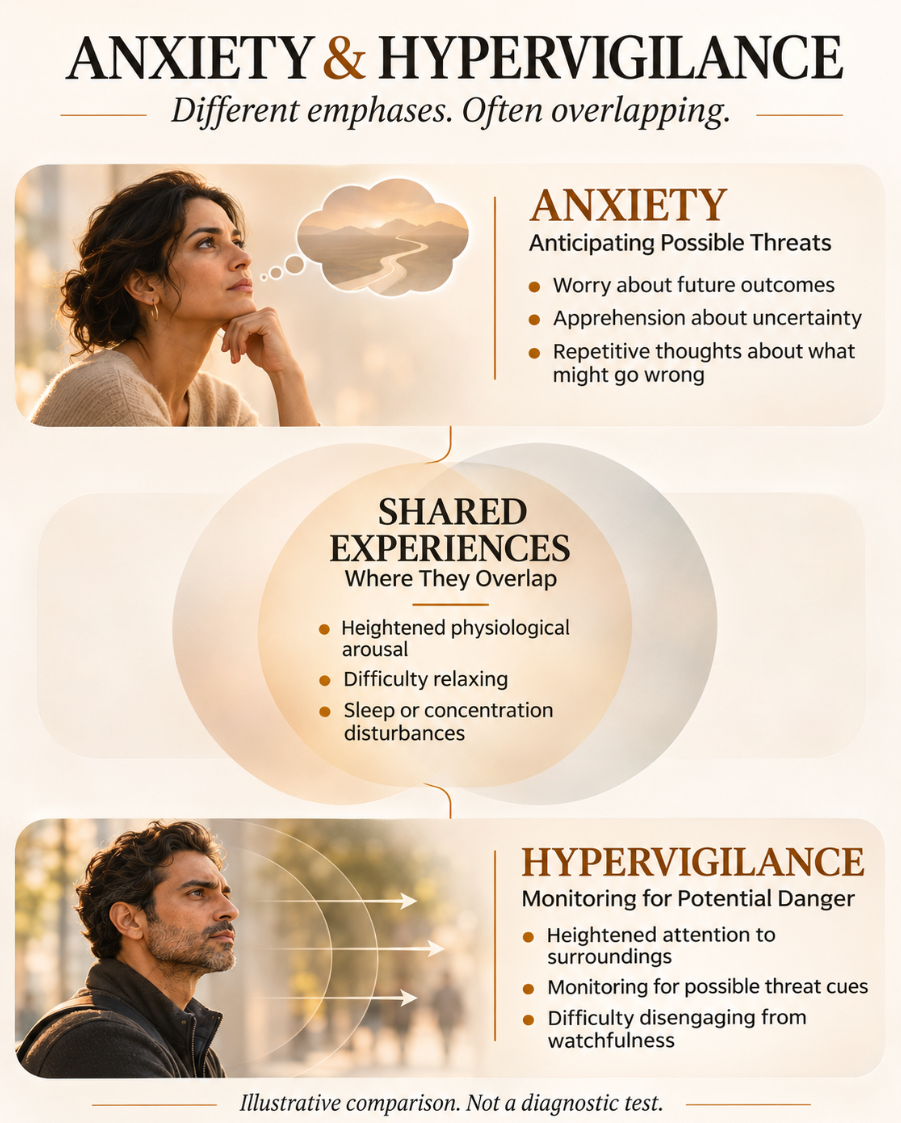
This illustrates a useful distinction. Anxiety often involves apprehension about anticipated events, accompanied by psychological and physiological responses. Hypervigilance involves heightened monitoring for potential threats, particularly in the surrounding environment.
The distinction is not absolute. Anxiety can involve intense
monitoring, and hypervigilance can coexist with persistent
worry. Understanding their different emphases helps us
describe what someone may actually be experiencing.
When the Two Begin to Reinforce Each Other
Consider someone who becomes concerned about the security of their home. They begin checking the locks more frequently, paying closer attention to unfamiliar sounds and interpreting ordinary noises as possible warnings.
Increased monitoring may draw their attention to more ambiguous signals, which can generate further concern. Worry encourages additional checking, and checking provides more opportunities to notice something potentially troubling.
This is one possible pattern, not a diagnosis. Repeated checking can have different causes, including realistic safety concerns and several psychological conditions. What interests me is how anticipation, attention and behaviour can influence one another.
Previous experiences matter too. Following a frightening event, someone may remain particularly attentive to reminders of what happened. Hypervigilance is recognised among the symptoms associated with post-traumatic stress disorder (PTSD), although its presence alone does not establish that diagnosis.
Why the Body Cannot Tell Us Which Is Which
Anxiety and heightened threat monitoring can produce overlapping physiological responses. Heart rate may increase, breathing patterns may change, muscles may become tense and sleep may be disrupted.
Through my work at MI.BO., I have become increasingly interested in how physiological observations relate to people's reported experiences. But a measurement cannot independently tell us whether someone is anxious, hypervigilant or responding to another demand.
Heart rate and heart rate variability are influenced by activity, sleep, illness, medication and many other factors. They can provide useful information about physiological regulation, particularly when examined over time and in context, but they are not diagnostic tests for anxiety or hypervigilance.
This is why I resist assigning psychological explanations to isolated physiological scores. Understanding what someone is experiencing requires more than knowing how their body responded.
Where NeuraGrip Enters the Discussion
My interest extends beyond distinguishing anxiety from hypervigilance. I want to understand why protective readiness sometimes appears to persist across changing circumstances, even when an immediate challenge has passed.
This question contributed to the development of NeuraGrip, the framework explored in YOU ARE NEURAGRIPPED. Within it, I use autonomic bracing to describe a proposed pattern of sustained physiological readiness.
Neither NeuraGrip nor autonomic bracing is an established clinical diagnosis. They are working concepts intended to encourage further observation and investigation, not replace recognised conditions such as anxiety disorders or PTSD.
Understanding Before Labelling
If you recognise these experiences, consider what repeatedly captures your attention. Are you anticipating what might happen, monitoring for signs of trouble, or experiencing both? Does your response change when circumstances become more predictable, and is it affecting your everyday life?
These are questions for reflection, not a diagnostic checklist. Persistent distress, disrupted sleep or difficulty functioning deserves professional assessment. Effective support depends on understanding the causes, not simply choosing the most familiar label.
Before trying to quiet the alarm, we need to understand what it may be responding to.
For me, that is the value of distinguishing anxiety from hypervigilance. It allows us to move beyond describing everything as stress and begin understanding the different ways our thoughts, attention and physiological responses interact.
Further Reading
- National Institute of Mental Health. Generalized Anxiety Disorder: What You Need to Know.
- National Institute of Mental Health. Post-Traumatic Stress Disorder (PTSD).
- U.S. Department of Veterans Affairs, National Center for PTSD. PTSD and DSM-5.
Topics in this article

Aseem Gupta is the founder of MI.BO., creator of the NeuraGrip™ framework and author of YOU ARE NEURAGRIPPED.
About Aseem · NeuraGripped.com · MI.BO.life · MIBOSelfie.com